What happens when the world doesn’t end? (2 Peter)

Bible and magnifying glassEvery now and then, one of the books in the New Testament annoys me so much I can’t even talk about it, and must move on. That was 1 Peter. Hopefully the sequel won’t suck as much.

The Second Epistle of Peter

Chapter 1

The chapter opens with a florid, ostentatious greeting and introduction. This chapter exists to establish credibility for Peter and the church elders. He recounts that he and other disciples were there to hear the heavenly voice say “This is my son…” when Jesus was baptized. Was Simon Peter a disciple of Christ’s at that point in Jesus’s life? Because I don’t remember it that way. I thought that Jesus gathered Peter after being baptised and starting his ministry in full. Perhaps I am mistaken in that.

Or not. Re-reading this chapter, I see that Peter is describing two events. In the first is the baptism, and he is not claiming to have been present at that. The second event is when the disciples were with Jesus on the “holy mountain.” This is when the apostles heard the Voice of Heaven.

Chapter 2

My god this chapter is brutal. It is a combination of fearmongering and smearing. It may be one of the meanest chapters in the whole New Testament! The fun starts immediately, the first sentence stating “there are false prophets and false teachers among you trying to use destructive heresies upon members of the church. These people are doomed for destruction. After all, God did not spare angels who sinned, but cast them into hell. He destroyed all humans living on the earth with the exception of Noah and family. God destroyed Sodom and Gomorrah, burning them down to the ground.

Now that fear of what the Lord will do to the false prophets is out of the way, it’s time to smear and slander the false prophets. They indulge in fleshly pleasures, slander glorious things, have parties in the light of day (huh?), commit adultery, seduce others away from the true teachings of the church. One imagines that the “true” teachings are those of Peter and not of others. The false prophets are dogs that return to eat their vomit, or pigs that are back to wallow in the mud.

Dear lord, what caused that all-out attack?

Chapter 3
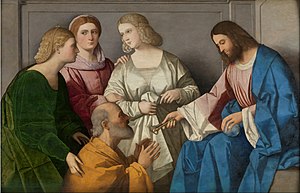
Jesus Gives the Keys to Peter
Image via Wikipedia

So what crime was it that inspired the rant that was Chapter 2? What made Peter fly off the handle so completely? Interestingly enough, it is something that I brought up in my review of 1 Peter: the earth didn’t come to an end when the apostles said it would. The apostles had been saying “repent, for the end of the earth is nigh,” but the world kept stubbornly refusing to destroy itself, and Jesus kept stubbornly not returning. More and more people noticed this, and they started complaining about it. They started mocking the apostles, asking why nothing had changed. Peter tries to retcon an answer, saying that earth will be destroyed by fire, but God is waiting to do so to allow others time to repent of their sins.

Well….

Peter insists that the day of the lord will still come like a thief in the night. And that it will be soon. But soon to God is not necessarily soon to man. A single day and a thousands years are equivalent to God. He cannot be rushed. And Peter now has an easy answer to use when someone asks why Jesus hasn’t returned in the future.

Conclusion

That was… weird. This entire book is a response to the growing questions about the earth’s continued existence. It is like Peter believes he can re-write the previous gospels and letters with a single letter of his own. The contents of which is basically: “we were just joking when we said Jesus’s return was coming soon.” I assume that the critic’s arguments were starting to win people away from the church – or at least away from the church the apostles were establishing – at a steady enough rate that they couldn’t be ignored. Instead they were slandered and threatened with being burnt to a crisp and thrown into hell by God’s wrath.

Whatever way you slice it, Peter sounds defensive, and his arguments are almost desperate. It’s kind of sad, actually.

Up next: John’s up to bat

New installments of The New Testament In Review will be posted each Tuesday and Thursday. The new posts will always be on my blog, http://biffster.org. The entire series is accessible via http://biffster.org/ntir. If you are one of my Facebook friends, you can get an advance preview on my Facebook page. You can also follow me (@biffster) on Twitter to be alerted to new posts.

Enhanced by Zemanta

Interchangeable apostles – 1 Peter 3-5 (NTiR)

Bible and magnifying glass

Chapter 3

Here’s the reason I don’t like Paul’s letters, and I am beginning to dislike Peter’s: they are not about Christ’s teachings, but are instead about seeing Christ as a god figure. Instead of talking about the man, they talk about the concept (“exalt Christ as Lord in your hearts”). Instead of internalizing the message – as James did – Peter keeps everything at an external, exterior level. While James defined sin and why a person should watch their thoughts, Peter brings such wisdom as “who will harm you if you are devoted to doing good” (ignoring the fact that, in Chapter 2, he said that people will be harmed for doing good) and “Baptism […] saves you also, not by removing dirt from the body.”

Another reason to dislike both? Blatant sexism. Just like Paul, Peter exhorts women to submit to their husbands. Women should follow the example of Sarah and obey their husbands in everything. This is the way that holy women have done in the past. What, social progress wasn’t considered a good thing back then, either?

Chapter 4

Paul’s letters made it sounds that he expected Jesus to return soon. Peter states this straight out: “The end of everything is near.” That was 2,000 years ago. Peter “keep using that word. I do not think it means what you think it means.”

Chapter 5

Church elders must be like Shepherds, who will be much like the Chief Shepherd, and will be given a crown of Glory when Jesus returns. I think that Peter reveals a lot about how he views himself and other church elders. He practically puts them on the same level as Christ (they are all shepherds. Jesus is chief, but still a shepherd like the rest of them). Elders will be reward with crowns of power. Church members should be submissive to elders… Well, you get the idea.

Conclusion

Ugh. At least it was a short letter. Peter has turned out to be just as infuriating as Paul. Actually, he sounds pretty much exactly like Paul. You can tell that they were on the same page with many aspects of the new church. Reading one is pretty much the same as reading the other. That provides internal consistency, but it is also preaching to the choir. Peter and Paul have a view for how the church should be arranged, what should be taught, how people should be guided. None if it seems much like what Jesus taught and how Jesus lived.

My recommendation is to skip this letter and re-read James.

Up next: What happens when the world doesn’t end?

New installments of The New Testament In Review will be posted each Tuesday and Thursday. The new posts will always be on my blog, http://biffster.org. The entire series is accessible via http://biffster.org/ntir. If you are one of my Facebook friends, you can get an advance preview on my Facebook page. You can also follow me (@biffster) on Twitter to be alerted to new posts.

Enhanced by Zemanta

Six of Peter, a half-dozen of Paul – 1 Peter 1-2 (NTiR)

Bible and magnifying glassAs I mentioned when I wrapped up my last entry, the second half of James, I was surprised to find that I liked James. It was a well-written, even-toned, intelligent, introspective work. James did a great job of distilling Christ’s message and giving examples of how that should be lived. The stress was on doing and saying and thinking how Jesus did, not as someone who is trying to co-opt the church does. That’s a huge difference, and major points for James.

And now, we move on to:

The First Epistle of Peter

Chapter 1

Only two sentences in, and I already have doubts about this book. Much of this reminds me of the letters from Paul. Boring, bland, superflous and ingratiating. “Therefore, get your minds ready for action by being fully sober, and set your hope completely on the grace that will be brought to you when Jesus Christ is revealed.” Stuff like that. To quote Inigo Montoya, “Let me explain. No, there is too much. Let me sum up.” Jesus’s spirit and blood is going to rescue everyone from sin and make the angels jealous. But people had better be good and not fall back into what they were doing before. Oh, and human glory dries up but the word of God lives forever.

Meh

Chapter 2

What is it with the New Testament authors comparing people to babies? “Like newborn babies, thirst for the pure milk of the word…” That is a very odd comparison to make. It seems condescending to me. It sounded condescending when Paul did it, too. Apparently Peter and Paul are more alike than I thought. Which might make for a painful book to read. Hopefully it’ll go fast though.

Peter comes up with an interesting idea. He is talking about it being good to get persecuted for doing the right thing. But people are going to beat you anyway, so “What credit is it if you sin and patiently receive a beating for it?” In other words, you are going to get your ass kicked one way or another. At least doing something good to deserve it. Enduring the beating will please god. Or something like that.

Oh, Christians are sheep. Seriously, Peter says this! “For you were like sheep that kept going astray…”

Apparently even Peter can be right about a thing or two…

Up next: Interchangeable apostles

New installments of The New Testament In Review will be posted each Tuesday and Thursday. The new posts will always be on my blog, http://biffster.org. The entire series is accessible via http://biffster.org/ntir. If you are one of my Facebook friends, you can get an advance preview on my Facebook page. You can also follow me (@biffster) on Twitter to be alerted to new posts.

Enhanced by Zemanta

Christ’s message personified – James 3-5 (NTiR)

Bible and magnifying glassThose of you who’ve been reading this series of articles probably noticed by now that I have a healthy dislike for Paul. I think that he was an overbearing personality who co-opted Christianity for his own goals, to push his own personal agenda. And since it feels like most of the New Testament to this point has been written by Paul, it follows that I haven’t found much to like – let alone respect – for quite awhile. Since the end of Acts of the Apostles, actually.

Imagine my surprise, then, to find a book that I am actually enjoying. A book that I am looking forward to reading more of. A book that I am starting to respect. If that doesn’t say a lot about the strength of the book of James, then I don’t know what else to say.

Chapter 3

James is trying to make a strong point here: Those who are looking to be teachers and leaders in the church need to make sure that they are living what they are teaching. Actually, more important than that, the teachers must make sure that they aren’t spreading discord in their church in the name of teaching or leading. James warns that just a few hurtful or jealous words could have devastating effects. “…but no one can tame the tongue. It is an uncontrollable evil filled with deadly poison. With it we bless the Lord and Father, and with it we curse those who are made in God’s likeness.”

It should be noted here that James is targeting this chapter directly at church leaders. The message within can be espoused by members of a church’s body, but James had a very specific audience in mind.

I can’t help quoting from this chapter. It’s a goldmine for how a Christian church should be run, for how church leaders should behave. “But if you have bitter jealousy and rivalry in your hearts, stop boasting and lying against the truth.” “For wherever jealousy and rivalry exist, there is disorder and every kind of evil.”

My respect for James continues to increase with each chapter of this letter.

Chapter 4

James decides that he should include others besides the leaders of the church.

As an aside: I cannot decide who this chapter is aimed at. For the first half seems generic, aimed at any member of the church. But it finishes up directed solidly at church leaders again (“‘Today or tomorrow we will go to such and such a town, stay there a year, conduct business, and make money.'”) It is possible that James starts talking to everyone and then hones in on the church leaders again… But the last part of the chapter feels like a continuation of the first, which’d make the first part of the chapter aimed at the church leaders also. Why does this make a difference to me?

Anyway, this chapter is all about sin and weakness. External behavior comes from internal desires. Fights and quarrels come from desire for things that can’t be attained. Loving the riches of the world makes one an enemy of god. God turns against arrogance. Redemption is at hand for whoever wants it. Resist the devil and he will flee. Come close to god and he will return the favor. Be humble, and god will exalt you.

Back to church leadership: don’t criticize others, don’t judge others, don’t boast because that is evil. Most importantly, if you know what is right but don’t do it, then you are guilty of sin.

That, my friends, may be the best definition and conceptualization of sin that I’ve ever read. It hits close to home, and speaks even more powerfully to me because of that…

Chapter 5

Whoa, didn’t expect this: James opens up Chapter 5 with a rant against the rich! “Today or tomorrow we will go to such and such a town, stay there a year, conduct business, and make money.” In the course of this rant (which includes condemnation for not paying servants fair wages) James ends up blaming the death of Jesus on the rich. I get the feeling that James was still very bitter about Christ’s death, just with the wording of that verse: “You have condemned and murdered the one who is righteous, even though he did not resist you.” That sounds like the laments of a friend. Or of a brother… who is this James? Must do some quick research:

A quick wikipedia search shows that there are a few theories on who James was. One that seems to fit with the vibe I got from that verse is that James was related to Jesus. That sounds right to me. But it is way out of scope for this, so I’ll move on.

James wraps up his book with encouraging words for the members of the church. Be patient, Jesus will return soon. Endure suffering, don’t fight amongst each other, tell the truth always, pray for each other, try to encourage others to stay on the path. Patience, as the farmer who awaits the harvest.

Conclusion

In case you hadn’t noticed, I really liked the book of James. Took me all of two chapters to do so. James’s letter has been calm but authoritative. James reprimands and praises with equal conviction and temperance. James doesn’t spend a lot of time invoking Christ’s name, nor trying to put himself above everyone else. Instead, he shows Christ’s teachings by example. Christ’s message flows throughout this book, in a more realistic, more honest way than in anything since Acts of the Apostles.

Ayup, I liked this book a lot.

Up next: Six of Peter, a half-dozen of Paul (1 Peter)

New installments of The New Testament In Review will be posted each Tuesday and Thursday. The new posts will always be on my blog, http://biffster.org. The entire series is accessible via http://biffster.org/ntir. If you are one of my Facebook friends, you can get an advance preview on my Facebook page. You can also follow me (@biffster) on Twitter to be alerted to new posts.

Enhanced by Zemanta

A return to Christ’s teachings – James 1-2 (NTiR)

Bible and magnifying glassJust when I thought I was onto the New Testament’s tricks, I get thrown a screwball. The book of James was actually written by James! Up until this point, Paul had been writing all of the letters, and book names were deceiving. Now we are seeing some honesty! Honesty from the New Testament. Will wonders never cease?

[Note: That was a joke, don’t take offense.]

It appears that we are done with the letters from Paul. Or at least the names of the remaining books hints that. We have James, then two Peters, then three Johns (FULL HOUSE!!!!), one Jude and we finish things up with the book of Revelations. I’ll try and make sure I get my hands on some type of chemical substance to help figure out Revelations once we get there. Until then, let’s take a read through:

Epistle of James

Chapter 1

First things first: It seems very apparent that James has listened to Christ’s teachings, understood them, and has taken them to heart. Instead of Paul’s constant redefinition, James digs to the heart of Christ’s ministry. Or at least he does so in the first chapter. This starts with James telling his readers they should rejoice when times are difficult, since these types of times are a way to test a person’s faith and endurance.

A person should be willing to ask anything of god, because god gives lovingly. However, only someone who has true faith will receive what they wish for. Anyone with any type of doubt is unstable, and should not expect god to reward them. Which seems kind of harsh. Doesn’t working through doubt also make one’s faith stronger? James doesn’t believe so, but I’ve gotta think he is wrong on this point.

Rich people fade like a flower in the grass. Actually, there’s more to it than that. James is saying that a rich person gets lost in their own pursuits, and fade away in their own world.

James is all over the place in this chapter, but it is mostly good stuff, and I want to note a lot of it. Which means I am going to be all over the place in this review.

God never tempts a person. It is the person’s own desires that tempt a person, trying to lure the person away from the right path. Those who are able to overcome temptation are blessed. However, those who succomb are forever in trouble. Desire gives birth to sin, sin matures into death. A person should aim to rid themselves of all wickedness, to become a gentle spirit in the world.

The chapter finishes up with a great bit of imagery. People who hear the truth but do not act on that are like a man who looks at himself in the mirror. The second he walks away from the mirror, he forgets what he looks like. Likewise, someone who hears the truth but doesn’t act on it forgets the truth once they move on.

Chapter 2

Apparently some churches were already giving preferential treatment to the wealthy. James noticed that and tried to nip it in the bud. He does so in a way that feels like a parable. It isn’t a parable, but it has that same kind of narrative feel to it. James asks “aren’t the rich the ones who mistreat you, who drag you into court?” The poor are the ones who’ve been promised the kingdom of heaven. They should not be mistreated nor ignored nor humiliated, but treated as equal.

James is also very strong on the idea of works and faith. He believes that having faith is not enough. Someone who thinks that faith alone brings salvation is a fool.

Actually, the last half of this chapter sets up two recurring themes from James: that the poor should be given aid, and that faith must be manifested through works. James uses both for another narrative: a person with faith might offer words of encouragement for a neighbor who does not have any clothes or food. A person whose faith manifests in their works welcomes the neighbor into their own house to clothe and feed them. James’s point is clear: faith enriches a person, works enriches others. It takes both to be saved.

Up next: Christ’s message personified

New installments of The New Testament In Review will be posted each Monday and Thursday. The new posts will always be on my blog, http://biffster.org. The entire series is accessible via http://biffster.org/ntir. If you are one of my Facebook friends, you can get an advance preview on my Facebook page. You can also follow me (@biffster) on Twitter to be alerted to new posts.

Enhanced by Zemanta

Damn, what’d Esau do to you? – Hebrews 12-13 (NTiR)

Bible and magnifying glassLet’s hit the ground running…

Chapter 12

One must continue running the race set before them, enduring the obstacles put in one’s paths. If motivation is needed, one should look to Jesus. Christ fought against sin to the point that he shed his own blood; this is the example one must follow. There’s also a bit about discipline, how God disciplines a person as a father disciplines his son (what about mothers and daughters?). This should be accepted, as it will lead a person to better choices down the road.

The unknown author warns against becoming like that brings something to mind: Why was Esau treated so harshly? Reading the bible literally, Esau was guilty of nothing except for trying to get more food to eat. Not a lot, either, just a bowl of food. Esau then had another slap in the face when his brother Jacob tricked their father into giving Jacob the blessing that was Esau’s. I don’t see how Esau could be considered “immoral or godless.” The poor guy got screwed twice. And in the end, forgave and reunited with his brother.

Esau Selling His Birthright (painting circa 16...
Esau Selling His Birthright
Image via Wikipedia

This chapter ends with a very confusing logical argument: the author reads scripture, where God says “Once more I will shake not only the earth but also heaven.” The author says that the “once more” means everything that can be shaken is removed, leaving only what cannot be shaken. I am totally and completely baffled by this interpretation. It seems like the author of Hebrews is making a huge assumption, and reading in a lot more than is actually given in the passage. I don’t know where he was getting this from, but my guess is he was pulling it out of his ass.

Chapter 13

The letter finishes up with a list of commands that should be followed. People in the church should continue to leave one another. Strangers should be greeted with hospitality. Don’t commit sexual sins. (DRINK!!! Oh, no, wait, I think I said the drinking game was specifically for Paul disparaging sex.) Avoid the love of money and unusual teachings. Be generous, obey your leaders. Etc. Boiler-plate stuff, but the sentiment is good.

Conclusion

Hebrews is…. interesting. It was actually one of the harder books to get through. I am not part of the intended audience, nor are Christians, really. This letter was targeted specifically at Jewish believers who were converting to Christianity. As such, Hebrews is chock full of Jewish laws and customs, most of which I cannot relate to. It’s no wonder I was warned about Hebrews!

I did really like the history lesson given in Chapter 11. Otherwise, though, this book is far too droll, far too unrelatable. I am glad it is over!

Up next: Hello, James!

New installments of The New Testament In Review will be posted each Monday and Thursday. The new posts will always be on my blog, http://biffster.org. The entire series is accessible via http://biffster.org/ntir. If you are one of my Facebook friends, you can get an advance preview on my Facebook page. You can also follow me (@biffster) on Twitter to be alerted to new posts.

Enhanced by Zemanta